|
No. 004 · 6 min read |
|
|
|
Issue No. 004
Does more crema mean better coffee?
Some rituals are sacred.
Welcome back to The Dial. If this is your first issue, welcome to the ritual!
Last week, we explored why drinking your coffee a little cooler might help you discover flavours you've been missing. This week, we're looking at something you probably notice every time you make an espresso.
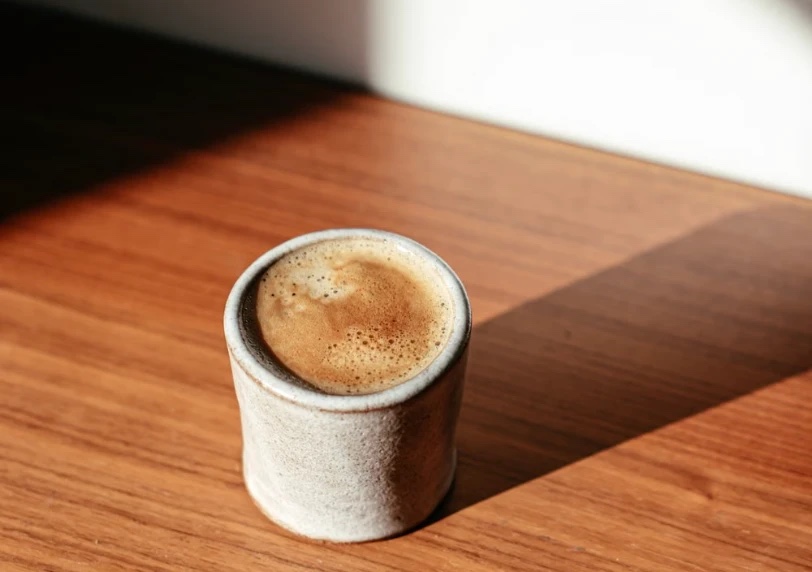
That beautiful golden layer sitting on top of your coffee.
Crema.
For years, it's been treated as a sign of a perfectly made espresso. The thicker, the better. Or so we've been led to believe.
But what if that isn't quite true?
We're getting to the bottom of what crema actually tells us, looking at a small upgrade that can help improve your espresso, discovering a rather unusual Brazilian coffee, and introducing something new from The Dial.
Six minutes. One coffee at a time.
Right, let's make some coffee.
|
|
|
In this issue
| 01 | The main pour Does more crema really mean better coffee? |
| 02 | The adjustment What your espresso is trying to tell you. |
| 03 | Worth drinking Craft House Coffee: a Brazilian coffee with a rather unusual story. |
| 04 | On our radar Introducing The Coffee Library. |
| | Plus: free print no. 004 Something for the wall, at the bottom of the email. |
|
|
|
01 · The main pour
Does more crema mean better coffee?
There's something incredibly satisfying about watching a freshly pulled espresso settle into the cup. That rich golden layer forming on the surface, the tiny bubbles slowly coming together. If you've got a bottomless portafilter it's practically a spectator sport.
And when you get a particularly thick layer of crema, it's tempting to think you've absolutely nailed it.
But here's the interesting part.
More crema doesn't necessarily mean better coffee.
Crema is the foam that forms when carbon dioxide trapped inside roasted coffee escapes during espresso extraction. Under pressure, gases and coffee compounds become dispersed through the liquid, creating those tiny bubbles that rise to the surface.
It's part of what makes espresso look, well, like espresso.
The amount of crema you get depends on several things, including how recently the coffee was roasted, the beans you're using and the roast itself.
Darker roasts, for example, can produce plenty of crema. Robusta beans also tend to create more of it than Arabica.
But none of those things automatically mean the espresso underneath tastes better.
In fact, crema can be surprisingly bitter when tasted on its own.
Some coffee professionals prefer to stir it into their espresso to create a more balanced flavour. Others even remove it entirely, arguing that doing so allows more delicate flavours to shine through.
And there's some fascinating research behind our obsession with it.
A 2016 study published in Food Research International explored how crema appearance influences people's expectations of an espresso. How a coffee looks can shape our expectations before we taste it.
In other words, sometimes our eyes have made up their minds before our taste buds get a chance.
Of course, none of this means crema is bad. It contributes to the texture, aroma and overall experience of drinking espresso.
It's just not the quality guarantee we sometimes think it is.
So next time you pull a shot with that picture-perfect golden layer, enjoy the moment.
Just remember, the best way to judge your espresso is still to taste it.
|
|
Source: Labbe et al., “Impact of crema on expected and actual espresso coffee experience”, Food Research International, 2016.
|
|
|
02 · The adjustment
What your espresso is trying to tell you.
Last week, we spoke about making small adjustments to improve your coffee. This week, we're going to look at something that can help you understand what's happening during an espresso extraction.
A bottomless portafilter.
If you've ever watched one in action, you'll know they're pretty mesmerising. Instead of your espresso flowing through the usual spouts, the coffee comes directly through the bottom of the basket.
But there's more to them than making your morning coffee look good.
They let you see what's actually happening during extraction.
With a traditional spouted portafilter, most of the action is hidden. You can judge your shot by its timing, weight and taste, but you can't easily see how evenly water is passing through the coffee.
A bottomless portafilter gives you another clue.
If the extraction is relatively even, you'll often see small streams of espresso gradually come together into a steady flow beneath the basket.
But if something's not quite right, you might notice a few telltale signs.
|
|
Telltale signs
| 01 | Spraying or spurting. Little jets of coffee shooting sideways can indicate channelling, where water finds an easier route through parts of the coffee puck rather than extracting evenly. | | 02 | Uneven flow. If coffee starts flowing heavily from one side of the basket, it might suggest uneven distribution or puck preparation. | | 03 | An unusually fast extraction. If your espresso starts rushing through, your grind may be too coarse, although dose and other factors can also play a part. |
|
|
|
Of course, a beautiful-looking extraction doesn't automatically mean a delicious espresso. And not every unusual-looking flow means something's gone wrong.
Taste is still the most important thing.
But being able to see what's happening gives you another piece of the puzzle when you're trying to dial in your coffee.
The little upgrade I'd recommend.
I've been using a bottomless portafilter with my own espresso setup, and it's one of those accessories that's genuinely useful when you're learning how to get more consistent shots.
Not only is it incredibly satisfying to watch, but it can help you spot potential issues with your grind or puck preparation that might otherwise go unnoticed.
If you're thinking about trying one, just make sure you choose the correct size and fitting for your machine.
|
|
|
|
And next time you pull a shot, pay attention to what's happening underneath. Your espresso might be telling you more than you think.
|
|
|
03 · Worth drinking
Brazil: Fazenda Araçaçu
Craft House Coffee Roasters · UK
|
|
|
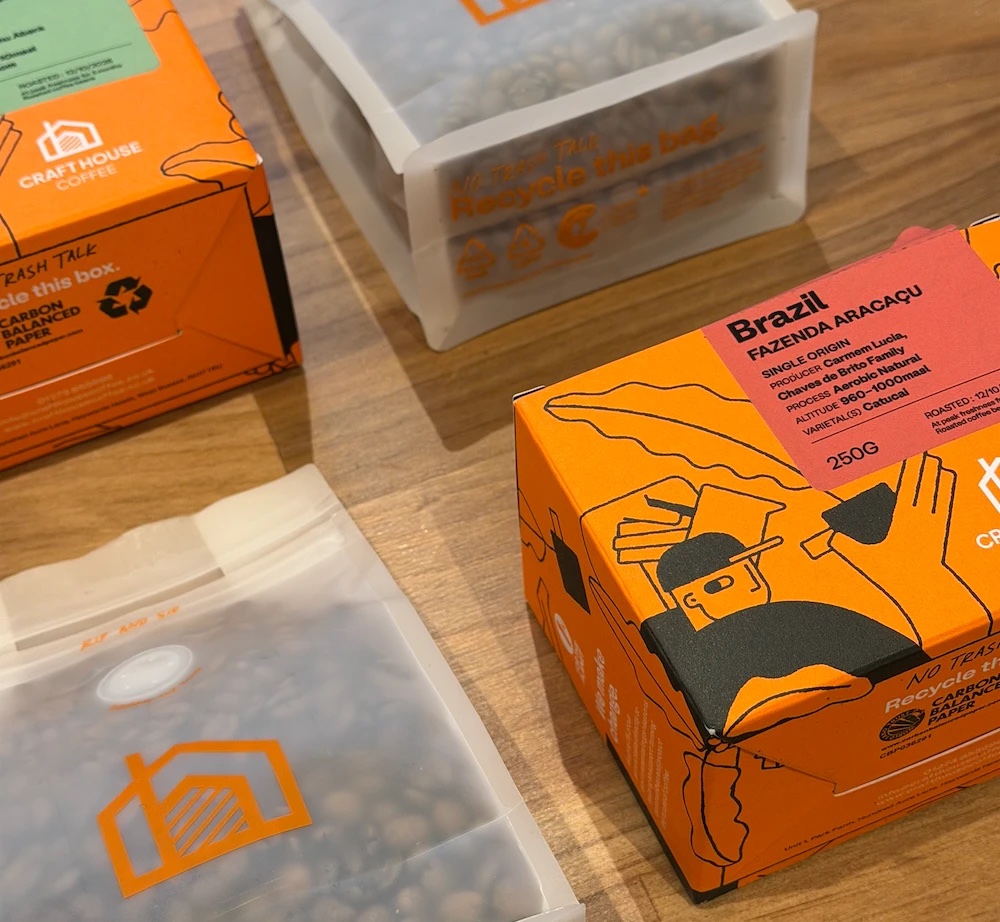
There are some coffees that catch your attention before you've even opened the bag.
This week's coffee from Craft House is definitely one of them.
It comes from Fazenda Araçaçu, a farm in the rolling hills of Três Pontas, Brazil, run by Carmem Lucia Chaves de Brito, better known as Ucha.
And Ucha isn't your average coffee producer.
A former president of the Brazil Specialty Coffee Association, she's become well known for her approach to sustainable coffee farming, earning recognition for her work in Brazilian agriculture.
Her farm uses solar power, with protected areas of natural forest providing a home for wildlife, including toucans, capybaras and wild cats.
During flowering, the farm also welcomes more than three million bees through a partnership with local beekeepers.
But that's not even the most unusual part.
Apparently, this coffee listens to music.
After the cherries have been harvested, processed and dried, the beans are moved into dark resting silos, where Ucha plays soothing music as they rest.
The idea is to create a calmer environment for the coffee before it's milled and shipped.
Whether the music actually makes a difference to the flavour is another question entirely, but you've got to admire the attention to detail.
The coffee itself is an aerobic natural Catucaí, carefully processed to bring out its fruity sweetness while maintaining a rich, creamy body.
Craft House describes tasting notes of blueberry, rum and vanilla, which is a pretty interesting departure from the more traditional chocolate-and-nut profiles we often associate with Brazilian coffees.
Behind every bag is a story. Sometimes it's the processing method, sometimes it's the people growing it, and occasionally it's a farmer playing music to a room full of coffee beans.
Whatever works, right?
|
The coffee Fazenda Araçaçu |
| Roaster | Craft House Coffee |
| Origin | Brazil |
| Process | Aerobic Natural |
| Tastes like | Blueberry · Rum · Vanilla |
| Price | From £12.45 / 250g |
|
|
|
|
Visit Craft House Coffee
|
|
|
04 · On our radar
Introducing The Coffee Library.
We've been working on something new behind the scenes, and we're excited to finally share it with you.
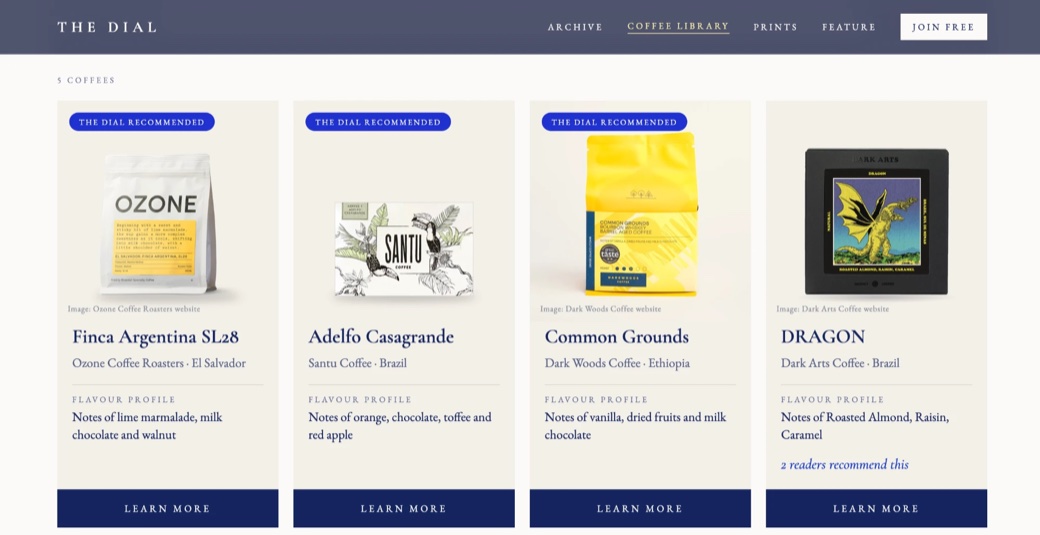
Introducing The Coffee Library.
A growing collection of great coffees, recommended by the people who drink them. You.
The idea is simple. Discover a coffee you love? Share it with us. We'll review your recommendation to make sure the details are correct and if approved, add it to the library for other readers to discover.
Think of it as a little corner of the internet dedicated to discovering your next favourite coffee.
You can browse coffees from different roasters, filter by brewing method or flavour profile and explore recommendations from fellow coffee enthusiasts.
We'll also be highlighting coffees previously featured in The Dial, so you can discover everything we've been drinking along the way.
No rankings. No complicated scoring systems. Just good coffee, shared by people who love it.
And the best part? The more recommendations we receive, the more useful the library becomes for everyone.
|
|
|
Two ways to get involved
| 01 | Explore the library. Looking for something new? Browse our growing collection of coffees, discover different roasters and find something that sounds right up your street.
Explore the Coffee Library → | | 02 | Recommend a coffee. Found a coffee you think everyone should try? Submit it through our website, and we'll review it for inclusion in the library. It doesn't need to be expensive, rare or from a famous roaster. If you love it, we'd love to hear about it.
Recommend a coffee → |
|
|
|
We're hoping this becomes something genuinely useful, built by our little community of coffee enthusiasts.
After all, the best coffee recommendations usually come from someone who's already had a cup.
|
|
|
Free print no. 004
Something for the wall
|
|
|
|
You made it to the bottom, so this one's on us. Another little piece of The Dial for your coffee corner. Print it, frame it, or stick it on the fridge. If it makes it onto your wall, tag @thedialcoffee.
|
|
|
|
Find us on Instagram →
|
|
P.S. Your tongue doesn't actually do all the work when tasting coffee. A huge part of what we experience as flavour comes from aromas travelling from the mouth to the nose. That's why coffee can seem so much less interesting when you've got a blocked nose.
The Dial
|
| |
|